Aransas-Wood Population of Whooping Cranes threatened by North Dakota Wind Project

Whooping Cranes by Laura Erickson

Whooping Cranes by Laura Erickson

Seventy-six groups led by American Bird Conservancy (ABC), one of the nation’s leading bird conservation organizations, have called on the U.S. Fish and Wildlife Service (FWS) to prepare a full Environmental Impact Statement (EIS) of the possible consequences of the proposed North Dakota, Merricourt Wind Project to the endangered Whooping Crane. FWS is considering issuing the first-ever Incidental Take Permit (ITP) to a wind farm for the killing of endangered Whooping Cranes and threatened Piping Plovers.

The project proposes to build approximately 100 turbines and 33 miles of access roads within a 22,400-acre area. Wetland stopover habitat is located in the project area and used during both spring and fall migration by all of the highly endangered Aransas-Wood Buffalo population of Whooping Cranes. FWS has already stated that the “mortality of any birds in such a small population also represents a loss of genetic material and represents a setback for recovery efforts.” Because of a recent change in the methodology of counting the cranes in this population, DOI does not even know with any degree of certainty, how many of these Whooping Cranes are actually left.  Read the entire story here.

American Bird Conservancy Coalition letter

Kentucky Wetland Restoration Attracts Endangered Cranes

For those of us in Kentucky who are having a hard time understanding how a Sandhill Crane season and the well-being of the eastern migratory population of  Whooping Cranes can possibly work together, the following is a thin ray of light in a dark landscape.

A wetland restoration project completed by USDA’s Natural Resources Conservation Service (NRCS) on nearly 900 acres of former cropland in western Kentucky has attracted a pair of Whooping Cranes! According to the USDA post, the cranes have been on the conservation easement since December 2012.  Kudos to the work done by NRCS to restore the bottomland hardwood wetlands into a haven for migratory wildlife, and to the landowner for putting it into a conservation easement.

To read more at the USDA blog:

http://blogs.usda.gov/2013/02/01/kentucky-wetland-restoration-attracts-endangered-cranes/

USDA post by Ray Toor_Kentucky Wetland Restoration Attracts Endangered Cranes

“The season for sandhill cranes does not close based on the presence of whooping cranes in the state”

KDFWR press release_20 DEC 2012_Whooping Cranes Spotted in KY Species off limits to Hunting

The headline and following response is by Rocky Pritchert, CWB Manager,  Migratory Bird Branch, KDFWR to the question of whether Kentucky had a plan in place to stop the Sandhill hunt if Whooping Cranes were reported in the state? 

“As you know, the whooping cranes that migrate through Kentucky are part of an experimental release effort conducted by the Whooping Crane Eastern Partnership (WCEP) of which KDFWR is a partner.  KDFWR and I have supported this project since WCEP’s inception. The WCEP recognizes the potential for sandhill crane hunting in eastern North America and does not advocate against legal hunting activity.  Legal hunting activity does not pose a threat to the success of the project.

KDFWR is following the protocol of our Sandhill Crane Hunting Plan.  This protocol was reviewed and approved by the Atlantic and Mississippi flyways and the US Fish and Wildlife Service, the lead agency responsible for the eastern whooping crane recovery effort.  KDFWR carefully considered the issue of whooping cranes when developing our hunt plan.  We have taken a number of steps to minimize the impact of a sandhill crane hunting season on whooping cranes.  Some of these actions are similar to those used in Kansas where whooping cranes from the truly “wild” population may be present.  These steps include, but are not limited to:

  1. Delaying season opening until mid-December.  The mid-December opening day is two weeks after the primary movement of fall migrating and Operation Migration lead whooping cranes.
  2. Hunters who apply for a permit must take and pass a bird identification test before that permit will be issued.
  3. Shooting hours are delayed until sunrise to ensure adequate light to assist in species identification.
  4. If a whooping crane is reported in the state during the hunting season, KDFWR will issue a news release alerting hunters of possible presence within the region but we encourage them to be vigilant at all times.…”

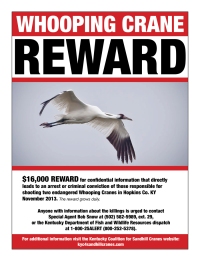
A Whooping Crane (WHCR) was reported on December 12, before the 2012-2013 season began, at the Sloughs WMA near Henderson, KY (WMA is closed to the public until March 15, 2013).  This area attracts large numbers of snow geese, ducks and therefore hunters.  The two WHCRs reported in Hopkins County had left the state, according to WCEP, by December 10, 2012.

The only KDFWR news release announcing the presence of Whooping Cranes in the state during the 2012-2013 season appeared on the KDFWR website December 20, 2012.


92 Sandhill Cranes killed in second Kentucky hunting season  

Barren River Lake is possibly the largest staging area for Sandhills in Kentucky. Of the 92 Sandhill Cranes killed this season, the Barren River Lake area lead in kills (three birds on the WMA with the rest on private land). Ironically, it is also the setting for the only organized Sandhill Crane-viewing in Kentucky, sponsored by the Kentucky State Department of Parks – Nature Watch Weekends, Jan. 25-27 and Feb. 8-10, 2013.

Sandhill cranes. Photo by David L. Roemer

Sandhill cranes. Photo by David L. Roemer

KILLS BY COUNTY:
Barren County – 66
Hardin County – 18
Hopkins County – 1
Harrison County – 2
Nelson County – 1
Fulton County – 2
Bourbon County – 2


Second of 3-year Experimental Sandhill Season Begins in Kentucky

Sandhill Cranes over Cecilia KY

Sandhill Cranes over Cecilia KY

Saturday, December 15, 2012 marked the beginning of the second in a three-year experimental Sandhill Crane season in Kentucky. The season will run until January 13, 2013 or until 400 Sandhills are killed, whichever comes first, when the season will be closed.

Earlier this year the Kentucky Department of Fish and Wildlife Resources held a series of nine Town Hall meetings across the state. As was the case last year, the public was encouraged to share its concerns with Commissioner Jon Gassett and the District Commissioners in a public forum. As of this post, the KDFWR had not yet posted its responses to the Town Hall meeting questions and comments.

At the 3rd District Town Hall a discussion between Ben Yandell of the Kentucky Coalition for Sandhill Cranes, Commissioner Gassett and 3rd District Commissioner, Stuart Ray took place. To read more click here: Transcription of KDFWR:Third District Town Hall mtg_15 Feb 2012 (Word doc)

There was a question from a hunter in the audience asking about the quota being raised if permits are purchased but not used to kill cranes. Commissioner Gasset: “You know, we will keep an eye on it and make sure we adjust appropriately. Raising the limit, it is an experimental season with the Feds right now. It’s a three-year season, so we have to be very careful about what we change on that. We can change how we do the drawing, but we have to be careful about how, you know, as far as changing limits, season lengths or that sort of thing.”

Commissioner Gassett’s response is telling as it indicates the Department is prematurely considering the possibility both of raising the quota and increasing the length of the Kentucky season. But, according to USFWS’s Eastern Population Management Plan, decisions such as these are based on an overview of the entire eastern population across the Mississippi and Atlantic Flyways. What happens to the population in one state affects the entire population.

Ongoing Concern for Eastern Migratory Population of Whooping Cranes

Whooping Crane photographed through windshield, Henderson KY, December 12 2012. Photo by Charles Crawford.

Whooping Crane photographed through windshield, Henderson KY, December 12 2012. Photo by Charles Crawford.

There is continuing, widespread concern concerning the safety of Whooping Cranes during the Kentucky hunt season as Sandhills and Whoopers often migrate together (on December 12, a Whooping Crane was photographed in Henderson, KY). While it is required by the Kentucky Department of Fish and Wildlife Resources to take and pass an on-line ID test prior to being issued a season permit, there is no guarantee a Whooper won’t accidentally be shot during low light conditions, misidentified plumage in juveniles, etc.

Hunters are directed to check daily by calling or monitoring the KDFWR website for updates as to the presence of Whooping Cranes in the state. While it is a good idea to close hunting when Whooping Cranes are present to prevent accidental shootings, it remains to be seen as to how well that works. The Eastern Migratory Population of Whooping Cranes is considered by USFWS as “experimental, non-essential” because the birds are part of a reintroduction program. They, therefore, are not classified as endangered as is the case with the Mid-continent Population – the Aransas/Wood Buffalo Population – that migrates between Canada and Aransas, Texas.

The EMP is highly sensitive to adult mortality and accidental shootings could easily cause the EMP to decline.  Currently, there are 115 Whooping Cranes in the eastern U.S. thanks to the reintroduction program of Operation Migration and the Whooping Crane Eastern Partnership (WCEP).

Hunting could hurt genetic diversity
of Eastern population Sandhill cranes

Sandhill Crane, Barren KY. Photo by David L. Roemer

With the first of a three-year, experimental Kentucky season on Sandhill Cranes just ended, a Wisconsin lawmaker has introduced a bill to allow hunting of the species in his state. At the heart of the bill is the alleged issue of crop predation by the cranes.

A red flag has been raised by Wisconsin scientists. In a recent study by avian genetics specialists at the University of Wisconsin, findings suggest genetic diversity may be key to long-term survival rates and stability of the eastern population of Sandhill cranes (differs genetically from western Sandhills).   Any hunt could adversely effect this vulnerable population only now rebounding from near extinction in the early 20th century.  Read more about the research here.


Prior to the Migratory Bird Treaty Act (MBTA) of 1918, sandhill cranes were “harvested” in an unregulated fashion, so that by the beginning of the 20th century the North American population had plummeted to an extraordinary low. The MBTA established protection for birds from uncontrolled hunting activities, and as a direct result, the
crane population slowly began to rebound.

The Sandhill Cranes that migrate through Kentucky each spring and fall are part of
the “Eastern Population” (EP), nesting primarily in southern Ontario, Michigan, and Wisconsin, and formerly wintering primarily in central Florida. However, in recent years, increasing numbers have short-stopped in migration to winter at places like Hiwassee Wildlife Refuge near Chattanooga, Tennessee and at Barren River Lake (making use of exposed mudflats) in south-central Kentucky.

This increase over the last decade in the eastern population of Sandhills prompted USFWS and the Mississippi and Atlantic Flyways Councils to approve a hunting season on the formerly protected, migratory species that has taken almost a century –
97 YEARS! – to recover from being hunted.

However, according to the Kentucky Department of Fish and Wildlife Resources (KDFWR) this hunt will have no negative impact on the eastern population of Sandhill Cranes or effect wildlife viewing opportunities. A point that would probably be argued
by the 400-500 cranes that may die this season, and by those opposed to the hunt (thousands of individuals not only from Kentucky but almost every state in the eastern United States), and shown otherwise by scientific data presented by the International Crane Foundation.

It is our hope that the other states in the Mississippi and Atlantic Flyways will make the right decision and celebrate Sandhill Cranes as a wildlife-watching resource rather than game bird.

So now, with heavy hearts, Kentuckians will scan the skies hoping for a glimpse of swirling cranes usually long preceded by their haunting, gurgling garoo calls  – bookends to the seasons – and wish them safe journey.

                                                                         – The Kentucky Coalition for Sandhill Cranes

Posted in KY Coalition for Sandhill Cranes | Tagged , , , , , , , , , , , , , , , , , , , , , , ,